Running Tuxedo ART jobs
What is it?
The Tuxedo ART Agent uses the Tuxedo ART artjesadmin utility to run and track every Tuxedo ART job scheduled by OpCon. This page describes how a job moves from OpCon submission to completion in the Tuxedo ART environment, and what the agent returns to OpCon along the way.
How a job runs
When OpCon submits a Tuxedo ART job, the agent does the following:
- Prepares the job. If the job definition includes variables, the agent writes them to a unique substitution file and passes the file name, along with the script name, to
artjesadmin. Tuxedo ART substitutes the values into the target script during job initialization. - Starts the job. The agent invokes
artjesadminto start the job. On success,artjesadminreturns the unique job ID assigned by the Tuxedo ART environment. - Tracks status. The agent uses the unique job ID to poll job status until the job completes.
- Returns output to OpCon. When the job completes, the agent retrieves the job log and the JES log information, then appends them to the OpCon job output. You can view the output through the OpCon Job Output Retrieval System (JORS).
Defining a Tuxedo ART job
You define jobs in OpCon using the Tuxedo ART job type in the Enterprise Manager. Each definition includes the following fields and tabs:
| Field or tab | Description |
|---|---|
| Script | The script artjesadmin runs. Required. |
| Owner | Set to * when left blank. |
| JESRoot Directory | Optional. The job's JES root directory. |
| Tuxedo Environment | Optional. The name of the Tuxedo environment script, which must end in .sh unless you enter it as a property token. |
| Variables tab | Values to substitute into the script during initialization. Each variable name starts with &. |
| Step Control tab | Step names and completion code ranges that trigger feedback to OpCon. See Step feedback. |
| Failure Criteria tab | Conditions that mark the job as failed. At least one failure criterion is required. |
You can only define a Tuxedo ART job if a Tuxedo ART machine has already been defined. For details, refer to Tuxedo ART Job Details in the Concepts online help.
Example
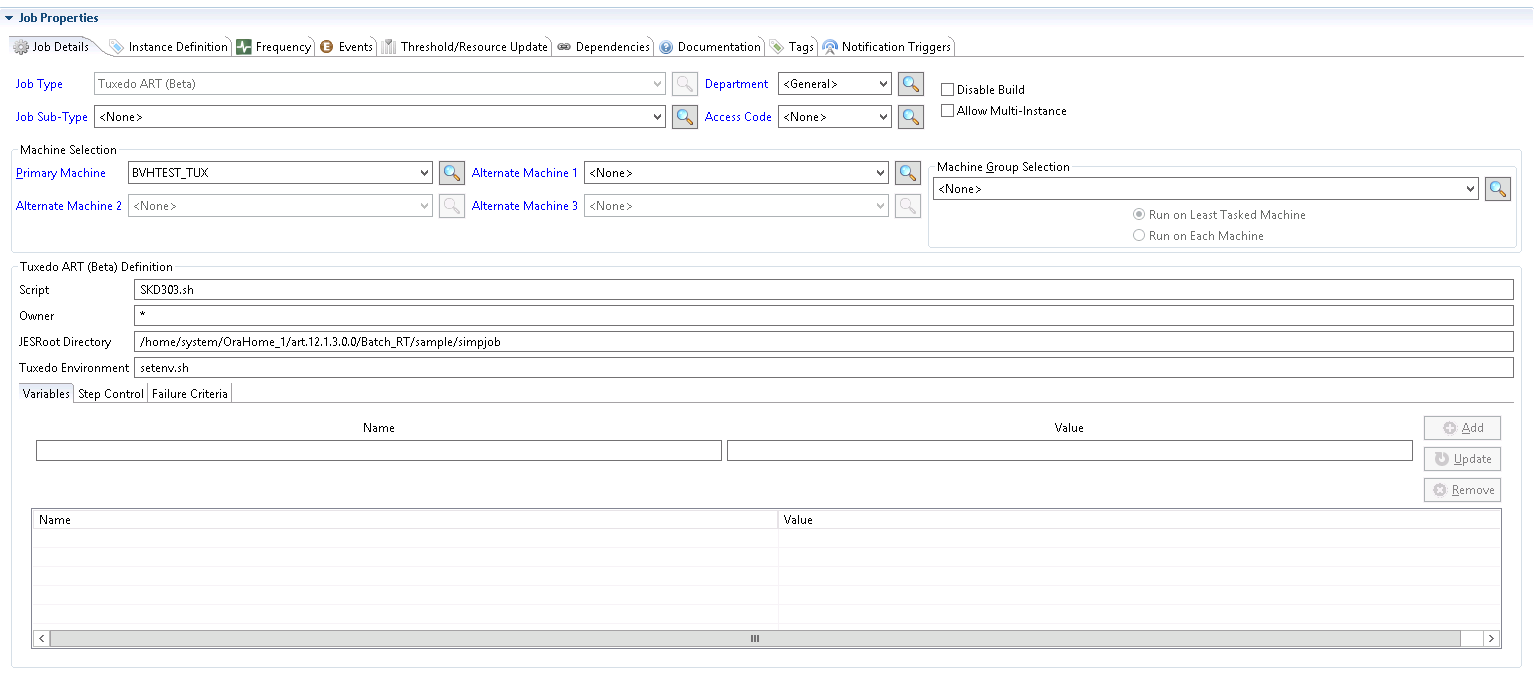
The image above shows an example Tuxedo ART job definition.
One application per machine
A Tuxedo ART Agent installation is bound to a single Tuxedo ART application by the JesrootDirectory setting in Agent.config.
If your environment has multiple Tuxedo ART applications installed in separate directories, install a separate Tuxedo ART Agent for each application directory and define a separate Tuxedo ART machine in OpCon for each.
Related topics
- Step feedback — Return step completion information to OpCon during a running job.
- Logging — How job log content is structured and returned to OpCon.
- Agent.config file configuration — The JesrootDirectory, SubstitutionFileDirectory, and
JobStatusCheck*settings referenced above.
Glossary
- artjesadmin — Tuxedo ART utility the agent uses to start jobs and monitor their status.
- JesrootDirectory — Configuration value that ties a Tuxedo ART Agent installation to a single Tuxedo ART application directory.
- JORS (Job Output Retrieval System) — OpCon component that retrieves job output information from the agent.
- Substitution file — Unique file containing variable definitions that is passed to
artjesadminso Tuxedo ART can substitute values into the target script.