Optional Modules (OPT)
What is it?
The Optional Modules screen enables or disables the MCP Agent's optional components and sets the variables that govern their behavior, including the Job Output Retrieval System, SMA File Transfer, and MSGIN file checking. Settings take effect when the Agent reloads its configuration.
- Toggle Automated Response, Job Adoption (Mixwatcher), File Monitor, and Resource Monitor independently to match the features your site requires.
- Configure JORS port numbers, File Transfer directions and ports, and MSGIN polling frequency to support job output retrieval, cross-platform file transfers, and external message input.
The Optional Modules screen allows the user to configure the following:
- Enable/disable general features such as Automated Response, Job Adoption, File Monitor, and Resource Monitor
- Define values for variables that enable Job Output Retrieval (JORS)
- Define values for variables that affect SMA File Transfer
- Define MSGIN variables
SMA Configuration and Operations Manager: SMAOPT
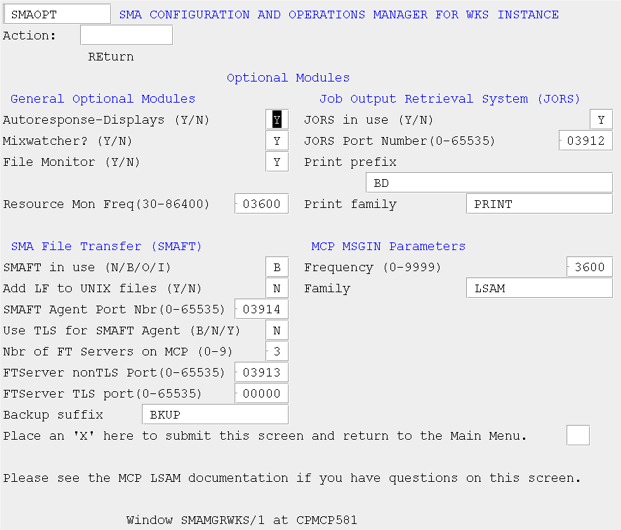
MCP Agent Configuration Settings: Optional Modules
The following sections describe each field on the SMAOPT screen. A default value is the value the MCP Agent sets when it creates a new configuration file.
General Optional Modules
Autoresponse-Displays
This field indicates whether the Auto-Response feature is active. Valid values are N and Y. The default value is N.
Mixwatcher?
This field determines whether the agent tracks external jobs. The default value is N.
- If Y, the agent tracks external jobs.
- If N, the agent does not track external jobs.
Once detected, tracked jobs are displayed in the Enterprise Manager.
File Monitor
This field indicates whether File Monitor should be started by the Resource Monitor. Valid values are N and Y. The default value is N.
Resource Mon Freq
This field sets the approximate number of seconds the Resource Monitor should wait between performance metrics samples. The default value is 1800 seconds. Valid values are 0 or 30–86400. A value of 0 turns off system resource monitoring. For example:
-
3600 = one hour
-
86400 = 24 hours
Job Output Retrieval System (JORS)
JORS in use
This field determines whether the agent initiates the *SMA/JORS/xxx program. Valid values are N and Y. The default value is N.
JORS Port Number
This field specifies the port number used for communicating job output information with the Enterprise Manager. The default value is 3110; valid range is 1–65535.
The JORS port number must also be configured on the Administration > Machines > Advanced Settings > Communication Settings > JORS Port Number in the Enterprise Manager.
Print Prefix
This field defines the initial node(s) of the print file names. The default value is BD.
The agent uses this value and the mix number (and, optionally, the usercode of the job) to locate the print files by preceding the job's mix number with this prefix (e.g., *BD/00jjjjj).
Although multiple nodes may be used to define the print file prefix, multiple print file prefixes are not supported.
Print Family
This field specifies the diskpack on which print files are located.
SMA File Transfer (SMAFT)
SMAFT in use
This field indicates the permitted directions for SMA File Transfer.
- If N, file transfer is not in use (default).
- If B, bi-directional transfer is okay.
- If O, only outgoing transfers are permitted.
- If I, only incoming transfers are permitted.
Add LF to Unix Files
This field determines how the file contents are stored and displayed on the UNIX system. Valid values are N and Y. The default value is N.
- If Y, the SMA File Transfer process will append a line feed (carriage control) to the end of each MCP record prior to sending the record to a UNIX platform.
The result on the UNIX platform is a text file that contains the UNIX newline character, which causes the MCP data to appear as records rather than a continuous stream of text.
This option only applies to SMA File Transfers using the ASCII, EBCDIC, or Default Text options - it does not apply to Binary transfers.
SMA Agent Port Number
This field defines the port number for the agent. The default value is 3130; valid range is 1–65535.
Use TLS for SMAFT Agent
Use this field to specify whether TLS is available to be used to secure communications between the MCP FTAgent and corresponding FTServer.
The default value is N.
- If B, the MCP FTAgent will support both TLS and non-TLS secured communications.
- If N, the MCP FTAgent will support only non-secured connections.
The SMAOPT screen accepts B, N, or Y in this field. The MCP FTAgent treats Y the same as N and supports only non-secured connections. To allow TLS-secured communications, enter B.
Nbr of FTServers on MCP
This field specifies the maximum permitted number of concurrent outgoing file transfers. The default value is 1.
If the File Transfer variable is set to a value other than "N," the Nbr of FTServers field must be at least 1.
FTServer nonTLS Port
This field specifies the port number used by *SMA/FTSERVER to communicate with the File Transfer agent when not using TLS. The default value is 3120; valid range is 0–65535.
The FTServer port number must also be configured on the Administration > Machines > Advanced Settings > File Transfer Settings > File Transfer Port Number in the Enterprise Manager.
FTServer TLS Port
This field specifies the port number used by *SMA/FTSERVER to communicate with the File Transfer agent when using TLS. The default value is 0; valid range is 0–65535.
The FTServer port number must also be configured on the Administration > Machines > Advanced Settings > File Transfer Settings > File Transfer Port Number in the Enterprise Manager.
Backup Suffix
This field specifies the suffix that should be appended to the name of the existing file prior to initiating a file transfer if backup is requested prior to the transfer.
MCP MSGIN Parameters
Frequency
This field sets the number of seconds between MSGIN file checks.
- Setting the MSGIN/ file check frequency to a low value increases overhead, but increases the frequency of file checking.
- Setting the MSGIN/ file check frequency to a high value minimizes overhead, but decreases the frequency of file checking.
Family
This field specifies the family on which MSGIN/= files reside. If multiple MCP Agent instances are in use, configure each agent instance to look for MSGIN/= files on unique families.