Working with Operation
What Is It?
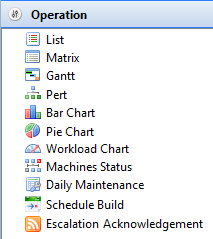
The Operation views display all schedules to which the current user account has access in the Daily tables. Each view provides a different way of looking at schedules and jobs.
Select any Operation function item in the graphic to learn more about that item.
Operation Toolbar Settings
The Gantt, PERT, Bar Chart, Pie Chart, and Workload Chart views, as well as the Daily list and Matrix views, rely on two toolbar settings located at the top-right of the screen to share selection information between views.
| Setting | What It Does |
|---|---|
| Listen for selection changes in other views | Required by the Gantt, PERT, Bar Chart, Pie Chart, and Workload Chart views to display individual dates and schedule information. In the Daily list and Matrix views, this setting also lets you display the same information in a different view (for example, viewing the same schedule from the Daily list view in the Matrix view). |
| Send the current selection to other views | Required by the Daily list and Matrix views to send dates and schedule information to the appropriate views. |
To view changes simultaneously in both the Matrix and Daily list views, refer to the Synchronizing Data between Matrix and List Views procedure.
Operation Right-click Menus
In the Operation views, right-click a schedule or job to open the Operation right-click menus.
Schedule Right-click Menu
Right-click a schedule in the Daily list and Matrix views to show the following menu items:
- Schedule Information: Refer to Schedule Information
- Schedule History: Refer to Schedule History
- Maintenance: Hovering over this menu item shows the following submenu items:
- Edit Daily Schedule:
- Daily list: Refer to Editing Daily Schedules
- Matrix: Refer to Editing Daily Schedules
- Edit Master Schedule:
- Daily list: Refer to Editing Master Schedules
- Matrix: Refer to Editing Master Schedules
- Check Schedule:
- Daily list: Refer to Checking Schedules
- Matrix: Refer to Checking Schedules
- Delete Schedule:
- Daily list: Refer to Deleting Schedules
- Matrix: Refer to Deleting Schedules
- Add Jobs:
- Daily list: Refer to Adding Jobs
- Matrix: Refer to Adding Jobs
- Edit Daily Schedule:
- Schedule Status choices: Dialogs display the schedule date and schedule name. Refer to Schedule Status Change Commands in the Concepts online help
- Update Jobs Statuses: The Update Job statuses dialog displays the schedule date and name and lets you update all jobs or jobs by status within the selected schedule. Refer to Jobs Status Change Commands in the Concepts online help
Job Right-click Menu
Right-click a job in the Daily list, Matrix, PERT, or Gantt views to show the following menu items:
- SubSchedule Information: For a Container job, displays the SubSchedule Information screen. Refer to SubSchedule Information
- Job Information: Refer to Job Information
- Job History: Refer to Job History
- Comment: Provides a dialog to enter a quick comment about a completed job to the history record for the most recent job instance.
- Daily list: Refer to Adding Job Completion Comments
- Matrix: Refer to Adding Job Completion Comments
- Gantt or PERT: Refer to Adding Job Completion Comments
- View Job Output:
- Daily list: Refer to Viewing Job Output
- Matrix: Refer to Viewing Job Output
- Gantt or PERT: Refer to Viewing Job Output
- Window To Host: Opens a dialog to open the emulator for the selected job's machine. For emulator configuration, refer to Setting Preferences for Window To Host
- Daily list: Refer to Opening Window to Host
- Matrix: Refer to Opening Window to Host
- Gantt or PERT: Refer to Opening Window to Host
- Maintenance: Hovering over this menu item shows the following submenu items:
- Edit Daily Job:
- Daily list: Refer to Editing Daily Jobs
- Matrix: Refer to Editing Daily Jobs
- Gantt or PERT: Refer to Editing Daily Jobs
- Edit Master Job:
- Daily list: Refer to Editing Master Jobs
- Matrix: Refer to Editing Master Jobs
- Gantt or PERT: Refer to Editing Master Jobs
- Delete Job:
- Daily list: Refer to Deleting Jobs
- Matrix: Refer to Deleting Jobs
- Gantt or PERT: Refer to Deleting Jobs
- Edit Daily Job:
- Job Status choices: Dialogs display the schedule date, schedule name, and job name. Refer to Jobs Status Change Commands in the Concepts online help
- SAP Child Processes: For SAP R/3 and CRM jobs, opens a dialog to monitor and/or restart child processes. The dialog can remain open while you work in the primary Enterprise Manager screen. Refer to SAP Child Processes in the Concepts online help
- Daily list: Refer to Monitoring SAP Child Processes and Restarting SAP Child Processes
- Matrix: Refer to Monitoring SAP Child Processes and Restarting SAP Child Processes
- Gantt or PERT: Refer to Monitoring SAP Child Processes and Restarting SAP Child Processes
- SAP Job Spools: For SAP R/3 and CRM jobs, opens a dialog to retrieve individual spool files generated by a job. Refer to SAP Job Spools in the Concepts online help
- Daily list: Refer to Viewing SAP Job Spools
- Matrix: Refer to Viewing SAP Job Spools
- Gantt or PERT: Refer to Viewing SAP Job Spools
Related Topics
- Schedule Information
- Schedule History
- Job Information
- Job History
- SubSchedule Information
- Setting Preferences for Window To Host
- Synchronizing Data between Matrix and List Views
Glossary
Container Job: A job type that runs a subschedule. Container jobs enable hierarchical schedule structures and support properties and events just like standard jobs.
Daily Tables: The OpCon database tables that hold the active, date-specific instances of schedules and jobs built to run. Changes to daily tables affect only the current day's automation.
Machine: A platform defined in the OpCon database that has an Agent installed. OpCon routes job run requests to machines via SMANetCom, and machines report job completion status back to SAM.
Schedule: A named container for jobs in OpCon, built for a specific date to create that day's automation. Schedules define build settings, frequencies, and the jobs that run within them.
Job: The fundamental unit of work in OpCon. A job defines what to run, on which machine, when to start, and what conditions must be met. Job results are tracked and can trigger events and notifications.