Performing Schedule Status Changes
Theme: Configure
Who Is It For? System Administrator, Automation Engineer
What Is It?
The Operations module allows you to perform schedule status changes.
To perform schedule status changes:
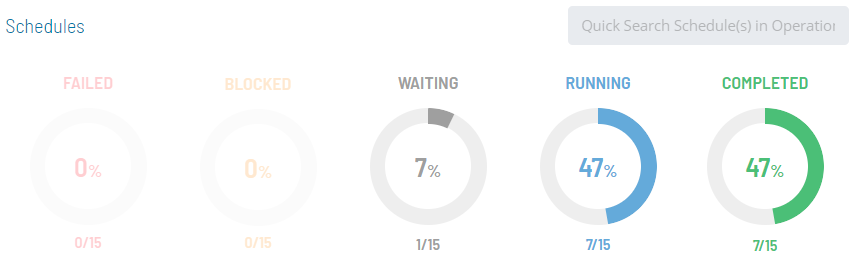
Select one of the five operation dials (Failed, Blocked, Waiting, Running, or Completed) or use the Quick Search field (type the keyword and press Enter) in the Schedules section on the Operations Summary page.
The Processes page will display.
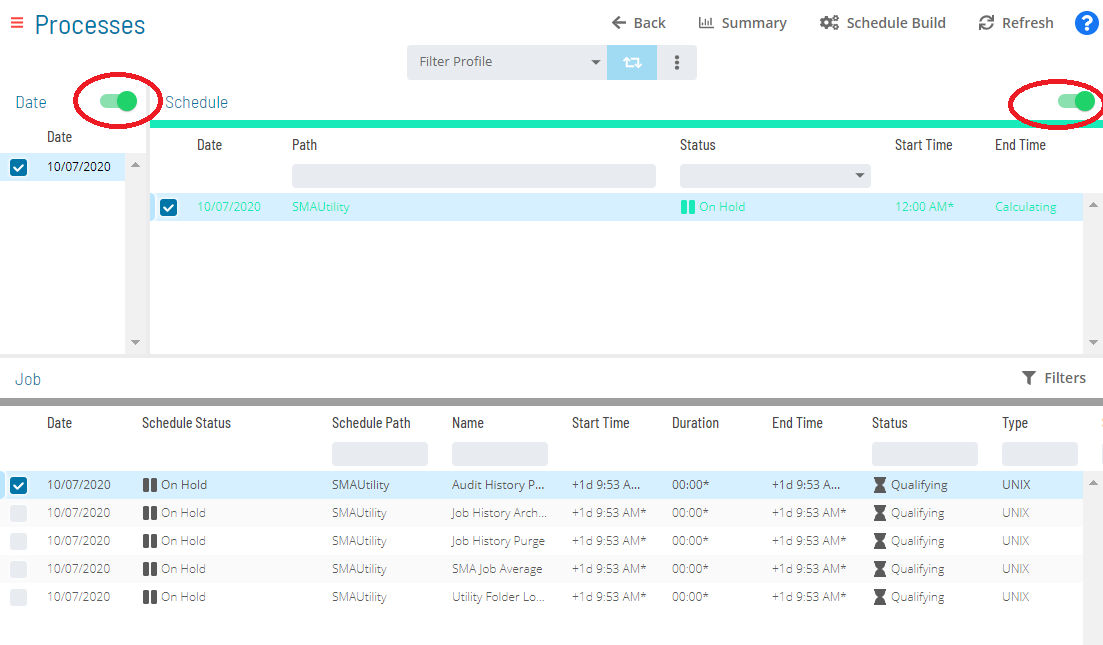
Ensure that both the Date and Schedule toggle switches are enabled. Each switch appears green when enabled.
Select the desired date(s) and schedule(s). Your selection(s) display in the status bar at the bottom of the page as a breadcrumb trail.
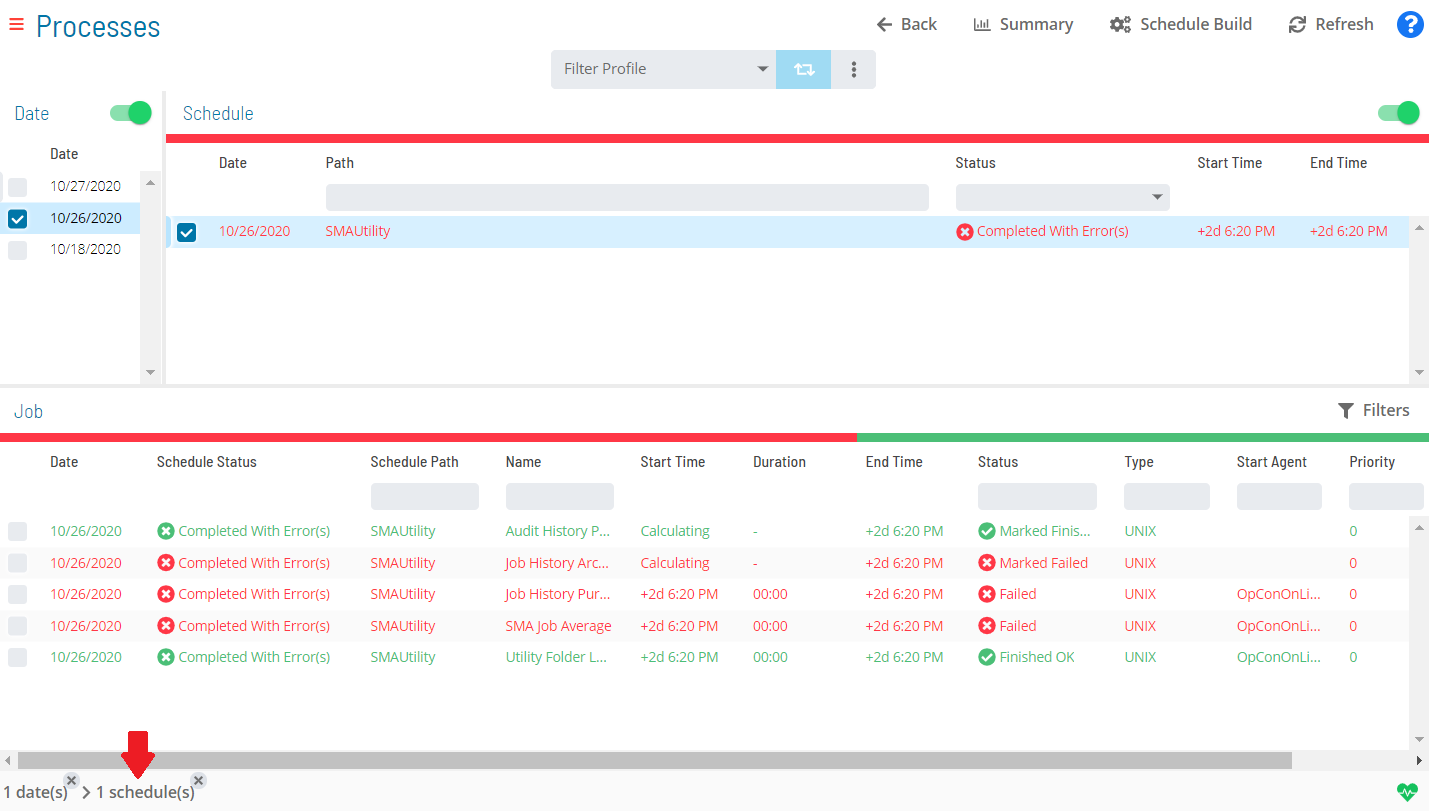
You may wish to filter and/or sort the schedule list:
- Filter: Use the Filter Bar above the list. Type a keyword in the appropriate field and press Enter
- Sort: Select a column heading to sort ascending (arrow pointing down); select again to sort descending (arrow pointing up)
Select the schedule record (e.g., 3 schedule(s)) in the status bar to display the Selection panel with the Schedule Status Update tab in focus.
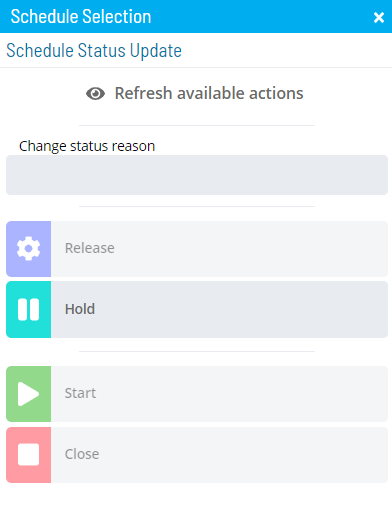
As an alternative, right-click any selected schedule in the list to display the Selection panel.
(Optional) Select Refresh available actions to verify which status update actions are available for the current selection. This is helpful when multiple schedules are selected, since all status update buttons are enabled by default.
(Optional) Enter or select a change status reason.
Depending on application configuration, the Change Status Reason list may store previous reasons entered for job or schedule status updates.
Select one of the following status updates to apply to the selected schedule(s):
Status updates applied to selected Schedule Names affect ALL jobs scheduled to run on that date, not only those visible in the current scope.
- Release: Releases the selected schedule(s) from a Held state. Jobs continue processing from where they stopped. Subschedules in Parent Hold status are also released
- Hold: Suspends processing of the selected schedule(s). Running jobs complete, but no new jobs start. Subschedules in Waiting or In Process status are placed in Parent Hold
- Start: Overrides the selected schedule's start date(s) and time(s) and runs them immediately. SAM begins processing as soon as this option is selected. Subschedules in Parent Hold status are also started
- Close: Marks the selected schedule(s) as Completed when they are still In Process only because they contain failed jobs
For more on job status changes, refer to Schedule and Job Status Change Commands in the Concepts online help.
Close the Selection panel when done.
 Related Topics
- Performing Job Status Changes
- Performing Bulk Status Job Updates (Schedule Level)
- Performing Agent Status Updates
- Viewing Job Output
- Viewing Job Configuration
- Using PERT View
- Managing Daily Processes
Configuration Options
| Setting | What It Does | Default | Notes |
|---|---|---|---|
| Sort | Select a column heading to sort ascending (arrow pointing down); select again to sort descending (arrow pointing up) | — | — |
| Release | Releases the selected schedule(s) from a Held state. | — | — |
| Hold | Suspends processing of the selected schedule(s). | — | — |
FAQs
Q: What happens to subschedules when a parent schedule is placed on Hold?
Subschedules that are in Waiting or In Process status are placed in Parent Hold. Running jobs within those schedules complete, but no new jobs start until the schedule is released.
Q: What does the Close status update do for a schedule?
Close marks a schedule as Completed when it is still showing as In Process only because it contains failed jobs. It does not resolve the failed jobs — it simply closes the schedule.
Q: What prerequisite toggle settings are required before performing a schedule status change?
Both the Date and Schedule toggle switches on the Processes page must be enabled (appearing green) so that date and schedule selections can be made together.
Glossary
SAM (Schedule Activity Monitor): The logical processor for OpCon workflow automation. SAM monitors schedule and job start times, dependencies, and user commands to determine job execution timing, and processes OpCon events.
Resource: A numeric variable in OpCon representing a finite pool. Jobs can be configured to require a set number of resource units to run, limiting concurrent executions and preventing resource contention.
Schedule: A named container for jobs in OpCon, built for a specific date to create that day's automation. Schedules define build settings, frequencies, and the jobs that run within them.
Job: The fundamental unit of work in OpCon. A job defines what to run, on which machine, when to start, and what conditions must be met. Job results are tracked and can trigger events and notifications.