Updating File Transfer Job Details
Theme: Configure
Who Is It For? System Administrator, Automation Engineer
What Is It?
In Admin mode, file transfer job properties can be updated or defined. For conceptual information, refer to File Transfer Job Details in the Concepts online help.
Only users with appropriate permissions can access the Lock button and update job properties. For details, refer to Required Privileges in the Accessing Daily Job Definition topic.
Without the Machine Privilege, you cannot edit the daily job definition.
Changes to job properties in the Daily Job Definition take effect immediately. If the job has already run, changes apply the next time it runs.
Updating File Transfer Job Details
To perform this procedure:
-
Select the Processes button at the top-right of the Operations Summary page
-
Enable both the Date and Schedule toggle switches. Each switch appears green when enabled
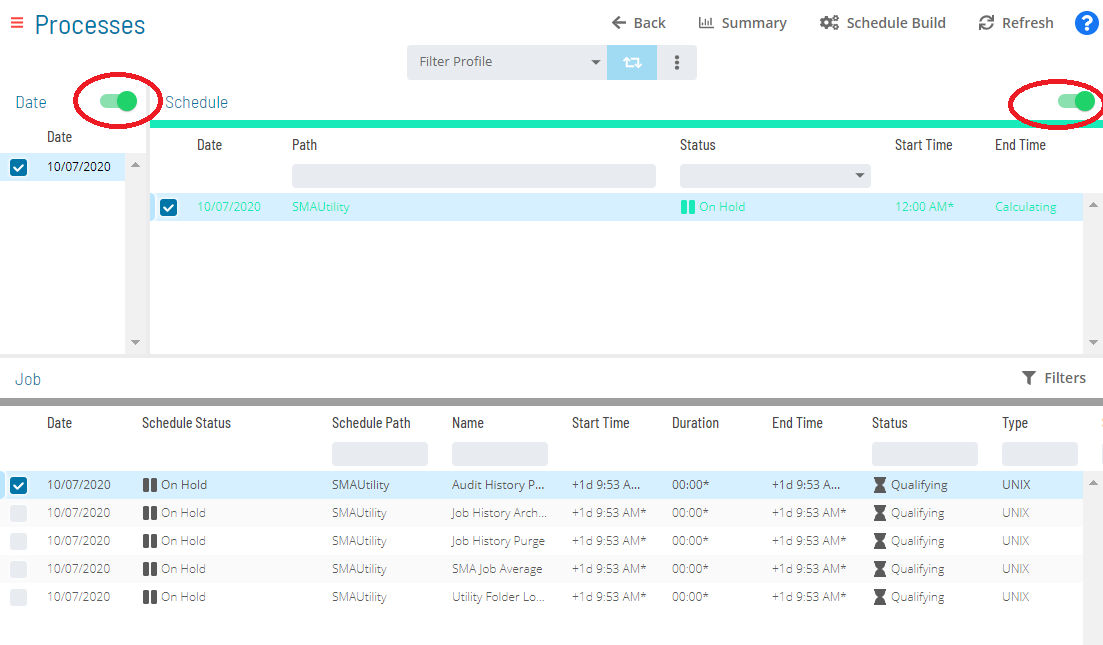
To update File Transfer Job Details, complete the following steps:
-
Select the desired date(s) to display associated schedules
-
Select one or more schedule(s) in the list
-
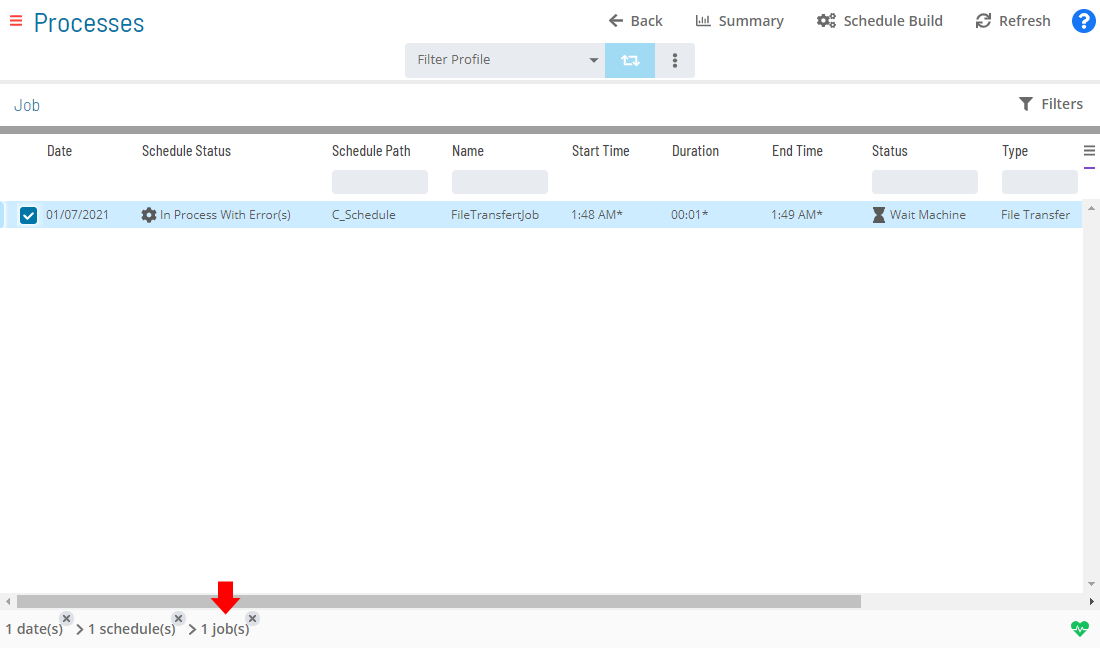
Select one job in the list. Your selection appears in the status bar at the bottom of the page as a breadcrumb trail
-
Select the job record (e.g., 1 job(s)) in the status bar to display the Selection panel
noteAlternatively, right-click the job in the list to display the Selection panel.
-a08280fb260704d662b129adb576a7c8.png "Job Summary Tab in Operations")
-
Select the Daily Job Definition button
 at the top-left corner of the panel. The page opens in Read-only mode by default
 -
Select the Lock button
 at the top-right corner to enter Admin mode. The button displays a white unlocked lock on a green background
  when enablednote
The Lock button is not visible to users without appropriate permissions.
-
Expand the Task Details panel
noteAll required fields are marked with a red asterisk.
In the Source frame:
Define the source file information:
-
Select the machine with the source file. Must be Windows or UNIX
-
Select the user with access to the file on the source machine
-
Enter the full path and file name for the file to transfer
-
Select the data type:
noteIf anything other than Binary is selected, file integrity is maintained but the file structure may be altered to suit the target platform.
- Text: Uses the platform's default text data type
- ASCII: Treats the file as a simple ASCII text file
- Binary: Preserves the file's structure during transfer
In the Destination frame:
Define the destination file information:
- Select the machine that will receive the file. Must be Windows or UNIX
- Select the user with access to the destination location
- Enter the full path and file name for the destination file
- Select the data type:
- Text: Uses the platform's default text data type
- ASCII: Writes the file as a simple ASCII text file
- Binary: Preserves the file's structure during transfer
In the Options frame:
-
If File Exists: Determines SMAFT Agent behavior when a target file already exists:
- Do Not Overwrite: Checks for the file before starting transfer; does not overwrite
- Overwrite: Transfers and overwrites any existing file
- Backup Then Overwrite: Backs up the existing file, then overwrites
- Append: Appends the source file to the destination file
- Backup Then Append: Backs up the existing file, then appends
-
Delete Source File: Determines deletion behavior after transfer (Windows agent only):
- No: Source file is not deleted
- Required: Job fails if source file is not deleted
- Preferred: Deletion is attempted but does not fail the job
-
Start Transfer On: Determines where the job initiates:
- Source: Starts on the source machine
- Destination: Starts on the destination machine
-
Maximum Transfer Rate (kbits/s): Valid values are 64, 128, 256, 512, 1024, 2048, and >2048 kbits/second
-
Compression: Supported types are tar, gzip, and zip:
- None: No compression
- Required: Job fails if compression does not occur
- Preferred: Compression is attempted
cautionBoth the agent and server must support the same compression type for compression to succeed.
-
Encryption: Supported types are 3DES, AES, and DES:
- None: No encryption
- Required: Job fails if encryption does not occur
- Preferred: Encryption is attempted
cautionBoth the agent and server must support the same encryption type for encryption to succeed.
-
TLS Security Override: Determines TLS Security usage for file transfers:
- None: TLS Security is not used by the SMAFT Agent
- Required: SMAFT Agent must use TLS Security; otherwise the job fails
- Preferred (Default): The OpCon job request assembly routine uses SMAFT Server Port numbers and TLS Capability flags to determine the TLS Security Mode value
In the Failure Criteria frame:
Select Fails if preferred settings not satisfied to fail the job when the transfer succeeds but preferred settings for Delete Source File, Compression, or Encryption were not met.
Select the Save button.
Configuration Options
| Setting | What It Does | Default | Notes |
|---|---|---|---|
| Delete Source File | Determines deletion behavior after transfer (Windows agent only): | — | — |
| Start Transfer On | Determines where the job initiates: | — | Valid values are 64, 128, 256, 512, 1024, 2048, and >2048 kbits/second. - Compression: Supported types are t |
| Maximum Transfer Rate (kbits/s) | Valid values are 64, 128, 256, 512, 1024, 2048, and >2048 kbits/second | — | Valid values are 64, 128, 256, 512, 1024, 2048, and >2048 kbits/second. - Compression: Supported types are t |
| Compression | Supported types are tar, gzip, and zip: | — | — |
| Encryption | Supported types are 3DES, AES, and DES: | — | — |
| TLS Security Override | Determines TLS Security usage for file transfers: | — | — |
FAQs
Q: How many steps does the Updating File Transfer Job Details procedure involve?
The Updating File Transfer Job Details procedure involves 9 steps. Complete all steps in order and save your changes.
Q: What does Updating File Transfer Job Details cover?
This page covers Updating File Transfer Job Details.
Glossary
TLS (Transport Layer Security): An encryption protocol used to secure TCP/IP communications between SMANetCom and agents, ensuring that job start and status data is transmitted safely.
Resource: A numeric variable in OpCon representing a finite pool. Jobs can be configured to require a set number of resource units to run, limiting concurrent executions and preventing resource contention.
Privilege: A specific permission granted through an OpCon role that controls access to a feature, function, or object type. Privileges are organized into categories such as Function Privileges, Machine Privileges, Schedule Privileges, and Access Codes.
Machine: A platform defined in the OpCon database that has an agent installed. OpCon routes job execution requests to machines via SMANetCom, and machines report job completion status back to SAM.
Schedule: A named container for jobs in OpCon, built for a specific date to create that day's automation. Schedules define build settings, frequencies, and the jobs that run within them.
Job: The fundamental unit of work in OpCon. A job defines what to run, on which machine, when to start, and what conditions must be met. Job results are tracked and can trigger events and notifications.
OpCon: Continuous' workflow automation platform. The OpCon server includes the database, SAM and Supporting Services (SAM-SS), and graphical user interfaces. agents installed on target platforms run jobs and report results.